Asheville's housing stock shapes every cleanout
Buncombe County sits at the core of western North Carolina's mountain region, and the housing that fills its hollows and ridgelines tells on itself the moment a cleanout begins. A significant share of the county's residential stock dates from before the mid-twentieth century: craftsman bungalows along Asheville's older neighborhoods, folk Victorian farmhouses out in Fairview and Weaverville, mid-century ranches stair-stepped into hillsides. Older homes mean older contents — workshop shelves stocked with solvents and stains, paint cans that predate water-based formulas, appliances that have occupied the same basement since they were new. It is not unusual to open a cleanout here and immediately find items that cannot legally enter a landfill without sorting first.
The region also carries a steady current of estate work. Western NC has drawn retirees and second-home buyers for decades, and when those properties transfer — through sale, inheritance, or a family decision to downsize — the volume of accumulated goods rarely fits in a few carloads. If you are working through a property that changed hands, the inherited house cleanout guide on this site covers the logistics specific to estate situations, where the contents may still need sorting before the dumpster is called.
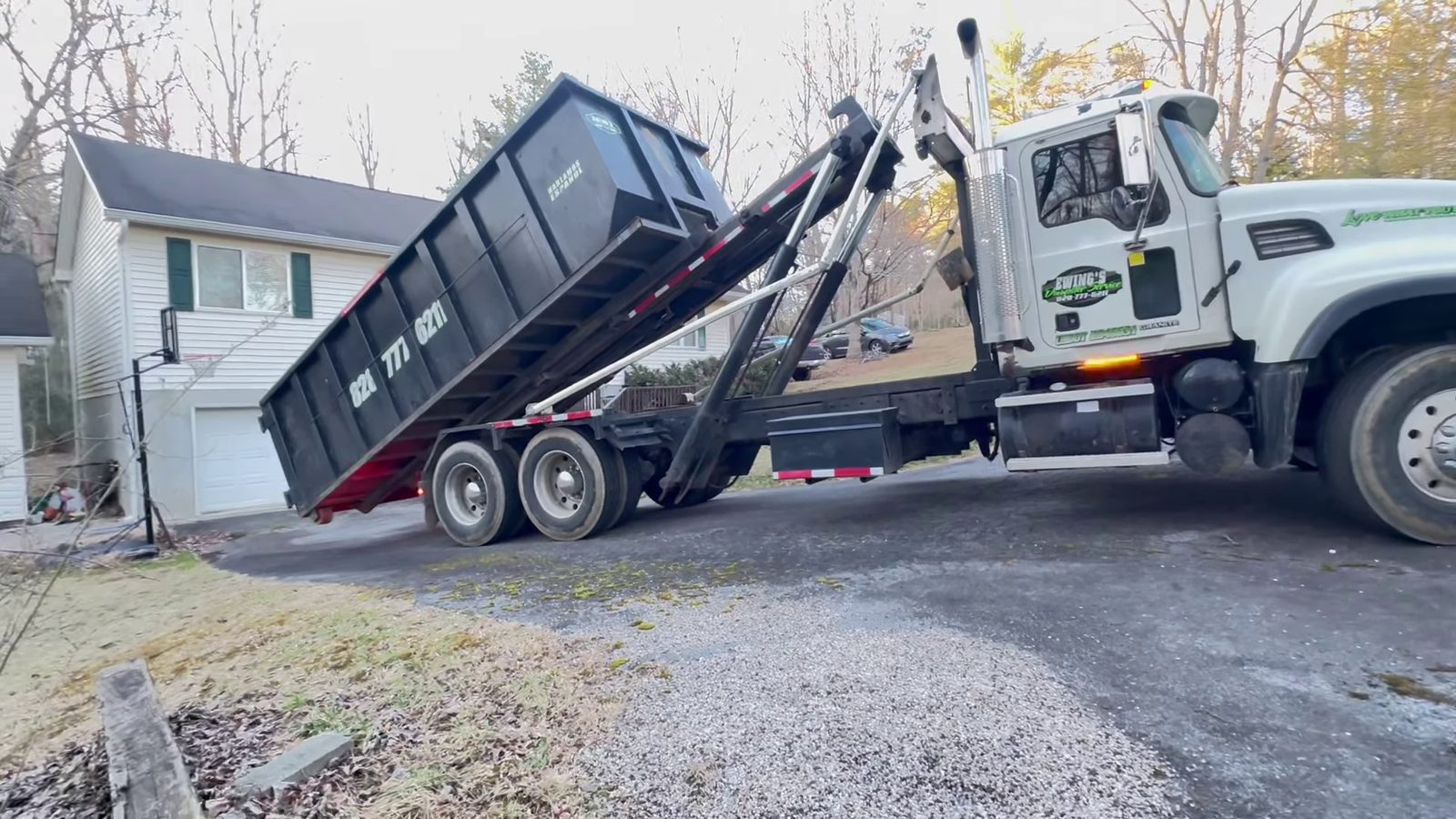
The terrain adds friction of its own. Many Buncombe County lots sit on grades steep enough that dumpster placement is a genuine decision rather than a default. Some driveways handle a fully loaded roll-off without issue; others cannot. That detail is worth confirming before the truck arrives, and it comes up again in the placement section below.
Matching the box to the job
Most cleanout calls go sideways at the size decision. Renting too small means a mid-job swap fee and a schedule delay; renting too large wastes money on cubic footage you will never fill. The table below maps common cleanout scopes to realistic sizes and what you can expect to pay with delivery and pickup included.
| Scope | Typical contents | Dumpster | Price |
|---|---|---|---|
| One-car garage or attic | Boxes, tools, shelving, light furniture | 10 yd | $199 |
| Basement or two-car garage | Furniture, stored goods, some appliances | 10–15 yd | $199–$280 |
| Full house cleanout (2–3 bedrooms) | All contents, carpeting, appliances | 15 yd | $280 |
| Estate cleanout, heavily furnished | Estate goods, furniture, decades of accumulation | 15 yd or multiple pulls | $280 per pull |
Weight matters as much as volume. Buncombe County cleanouts frequently surface tile, old masonry, concrete garden borders, and stacked firewood — all dense enough to hit weight limits before the box looks full. Load these items first along the floor so lighter goods fill in around them. If a detached garage is part of the job, check the section on prohibited materials before loading it. The garage cleanout guide and the 10-yard dumpster page both have more detail on working through cluttered outbuildings efficiently.
What cannot go in a roll-off in NC
North Carolina prohibits a defined list of waste streams from permitted solid waste facilities, and that prohibition runs straight through to what belongs in a residential dumpster. The NC DEQ Solid Waste Section maintains the state's current list; the short version for a house cleanout: no liquid paint (dried latex is generally acceptable, wet oil-based paint is not), no solvents or flammable liquids, no batteries beyond ordinary household alkaline cells, no propane cylinders, no motor oil, and no treated wood that meets the state's hazardous definition.
Older Buncombe County homes — particularly those built before 1980 — are more likely to have asbestos-containing floor tiles, pipe insulation wrap, or textured ceiling material. These require testing before disturbance, not a cleanout dumpster. Mixing suspect material into a roll-off creates legal exposure for the homeowner. If you find vintage floor tile or pipe wrap during a cleanout, set it aside and get it tested before the job continues.
The EPA's household hazardous waste guidance covers what to do with the workshop finds that cannot go in the box: oil-based paints, pesticides, old fertilizers, pool chemicals. Buncombe County holds periodic collection events where residents can drop these materials off at no charge. The working rule: if the product label reads "flammable," "corrosive," "toxic," or "reactive," it stays out of the dumpster.
Placement logistics and permits in Buncombe County
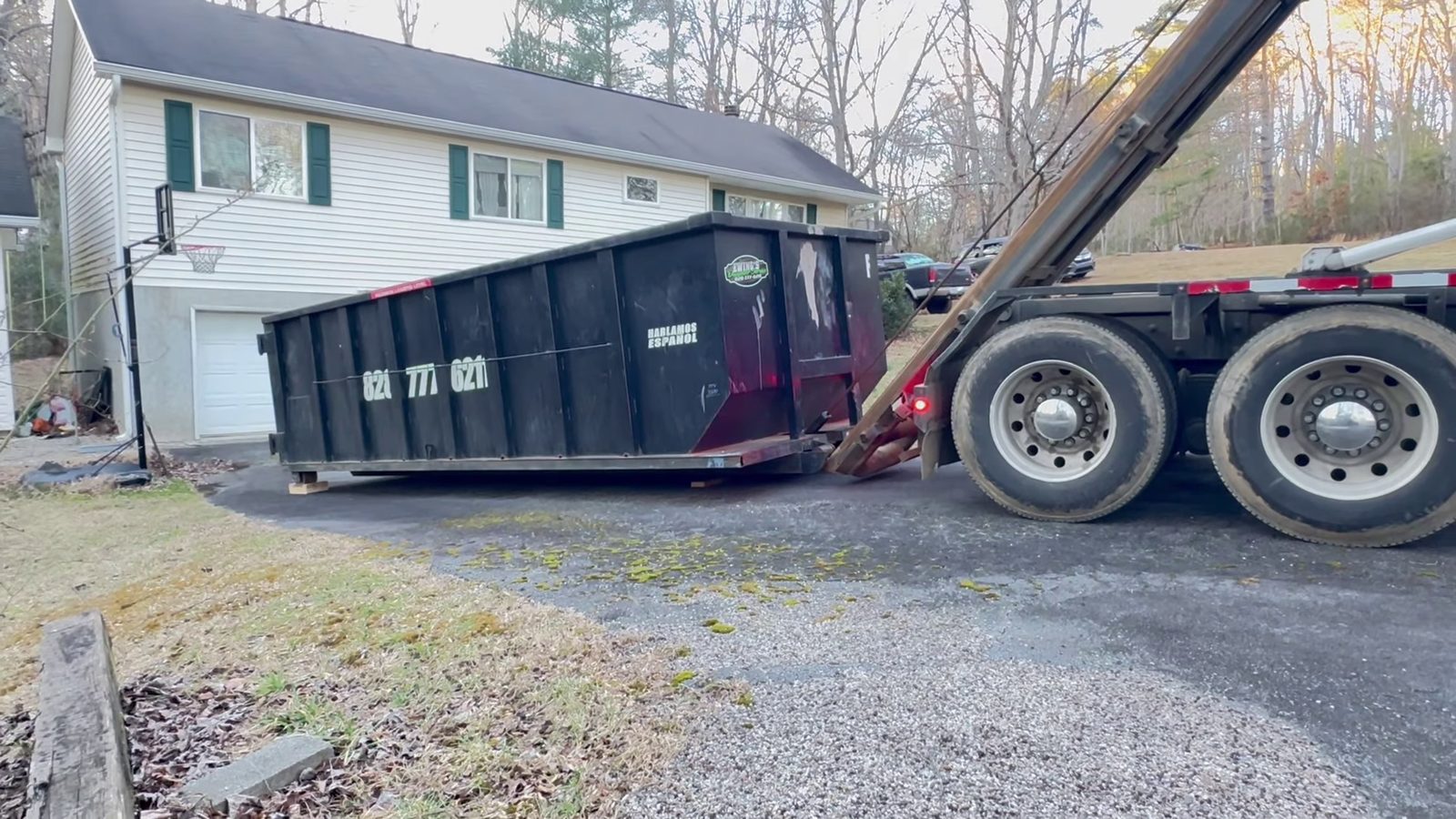
Placing a dumpster on a public road or right-of-way in North Carolina requires an encroachment permit from the NC Department of Transportation, and within Asheville's city limits a separate process applies through the City of Asheville. Most cleanouts sidestep this entirely by placing the box in the driveway: no permit timeline, no traffic control questions, and you control the loading schedule.
The driveway option fails when a lot is too steep for a loaded truck to navigate safely, or when a long gravel approach cannot support the axle weight. Some of the most dramatic ridgeline properties in the county come with driveways that look serviceable on a dry summer day but are a different conversation for a fully loaded roll-off. When that is the situation, curbside placement with the proper permit is the correct path.
Storm history in Buncombe County creates periodic demand spikes on dumpster availability. With 19 federal disaster declarations over 1973-2026, the county has seen flooding and wind events that generate sudden waves of cleanout and debris-removal need across the region. If your cleanout follows a weather event, available booking lead time can be meaningfully longer than a normal week would suggest — plan ahead.
Loading order and getting the most from one pull
A rental dumpster earns its cost when the box is loaded efficiently enough to avoid a second pull. These details matter on a cleanout job where the goal is to close in one visit.
Load heavy and dense items first — masonry, old tile, cast-iron fixtures, bundled hardwood flooring — along the floor before any furniture goes in. This keeps the center of gravity low for transport and prevents soft goods from trapping dense waste beneath them. Mattresses and large flat items should go in standing or at angles against the walls rather than lying flat across the floor, where they eat volume and block everything beneath.
Fill the box; do not heap it. Roll-offs cannot be legally transported with material sitting above the sidewall line. If the cleanout is running larger than expected, a mid-job call to schedule a swap is less expensive than waiting for the driver to arrive at an overloaded box. Know the fill line before you get close to it.
Set these aside before the dumpster arrives: televisions and monitors, computer equipment, tires, and refrigerators or freezers with refrigerant still in them. These require separate handling in NC regardless of condition. For jobs where renovation debris is mixed into a cleanout, the EPA's guidance on construction and demolition materials identifies what can be diverted to recycling streams rather than going to landfill — worth reviewing if the job includes significant clean wood, metal, or concrete.