The Slope Is the Variable Most Guides Skip
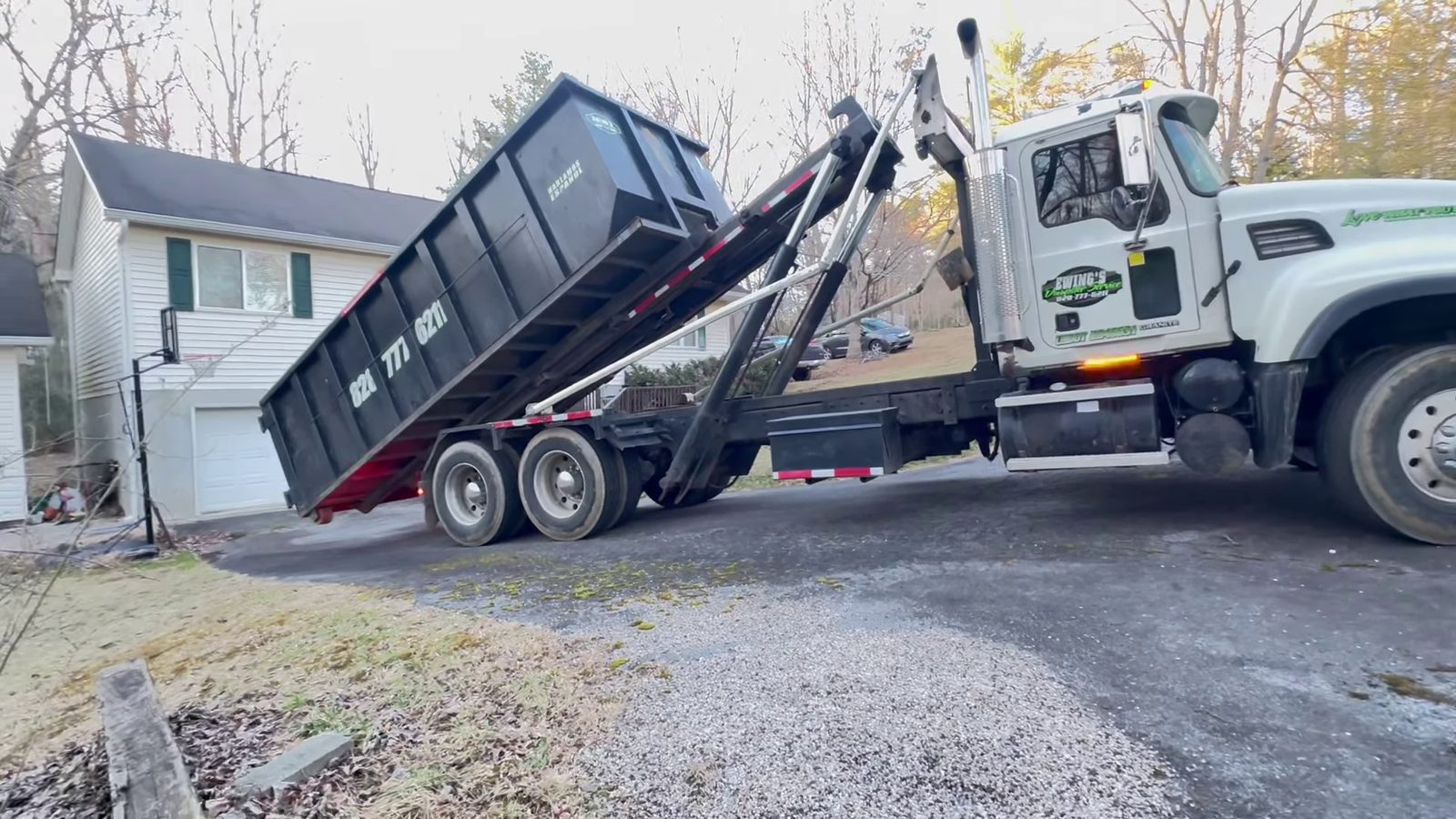
Asheville sits in a bowl formed by the Blue Ridge ridgelines, and the neighborhoods spreading from Pack Square climb in every direction. That topography is the reason a dumpster on a driveway in Buncombe County needs a different conversation than the same question in a flatter market. Driveways in Kenilworth, the Montford Historic District, West Asheville's Malvern Hills, and the lots above Lakeview Drive routinely run 8–15% grades. That slope changes the physics of a parked container: a roll-off container loaded with tile or framing lumber can reach 8,000–14,000 pounds, and on a grade, that mass doesn't distribute evenly. The downhill contact points carry a disproportionate share of the load — which is exactly where cracks originate.
Flat-country placement guides don't account for this. The question that matters in Buncombe County is not just "is my surface strong enough" but "where on the grade does the container land, and what is under it?" The county has seen 19 federal disaster declarations over 1973-2026, many involving water events that quietly erode hillside soil beneath driveways, leaving surfaces that look intact but have lost their base support. A driveway that passed visual inspection last summer may not carry the same point load this fall. If your property has a steep or narrow approach that makes delivery itself uncertain, that is a separate question covered at steep or narrow driveway access; resolve that before scheduling delivery.
The good news: slope-related driveway damage is almost entirely preventable. It requires knowing your surface, choosing the flattest available placement spot on the property, and using the right protection for the grade. The sections below work through each factor.
Surface Material and Age Determine the Real Risk
Asheville's housing stock spans more than a century. Montford's late-Victorian homes sometimes have brick or old concrete aprons. Ranch houses throughout Swannanoa and East Asheville tend to have asphalt installed in the 1960s–1980s. Newer construction uses reinforced concrete or paved aggregate. Material matters, but age and maintenance history matter more — a well-sealed 30-year-old asphalt drive can outlast a neglected concrete one installed five years ago.
| Surface | Common Failure Mode | Protection Needed |
|---|---|---|
| Asphalt, well-maintained under 10 years | Edge crumbling; heat-softening in summer | Full-length plywood runners; avoid hot-weather placement when possible |
| Asphalt, older or unsealed | Subsurface voids accelerate crack propagation under point loads | Plywood runners; inspect edge condition before delivery |
| Unreinforced concrete, pre-1980 | Stress cracks spreading from point-load contacts | Outrigger pads or plywood; keep container off expansion joints |
| Modern reinforced concrete | Surface spalling near edges | Pads recommended; moderate risk |
| Gravel or compacted dirt | Ruts and sinking at legs; low crack risk | Cribbing blocks to prevent settling |
| Brick or stone pavers | Individual units crack or displace under leg pressure | Steel plates to spread load across multiple pavers |
Temperature adds another variable. Asphalt softens in summer heat, and a container sitting for a week on a sun-exposed West Asheville driveway on an August afternoon can leave leg impressions even with otherwise adequate protection. Scheduling delivery in the cooler part of the day and placing the container in shade when available lowers the risk noticeably.
When Placement Location Triggers a Permit
The permit question depends on where the container sits, not on what is being thrown away. Private property placements and public right-of-way placements follow entirely different rules. In Asheville, the jurisdiction question is real: some streets within the city limits are maintained by the state, not the city, and that changes who issues the permit.
| Placement Location | Permit Required? | Issuing Authority | Key Notes |
|---|---|---|---|
| Private driveway, fully on your property | No | N/A | Standard homeowner placement; no approval needed |
| City sidewalk or curb lane | Yes — right-of-way encroachment permit | City of Asheville | Required whenever the container occupies or overhangs city ROW |
| City-maintained street or parking lane | Yes — temporary obstruction or encroachment permit | City of Asheville | Common in dense neighborhoods where short driveways can't fit the full container |
| State-maintained road or ROW | Yes — encroachment permit | NC Department of Transportation | Many roads inside Asheville city limits are state-maintained; confirm jurisdiction before applying |
Street placement is not unusual in Asheville's denser neighborhoods. South Slope, Oakley, and the River Arts District all have short urban driveways where a container won't fit without overhang. The encroachment permit process for a standard residential project is typically straightforward, though it adds lead time before delivery. Plan for it rather than around it. For a complete walkthrough of fees, timeline, and application steps, see dumpster permits in Asheville, NC.
Protection That Matches Your Surface and Grade
The protection conversation should happen when the job is planned, not the morning the truck calls to say it is twenty minutes out. The right choice depends on three variables: your surface material, the grade at the placement spot, and what you are loading.
Standard protection options, in order of load-spreading effectiveness:
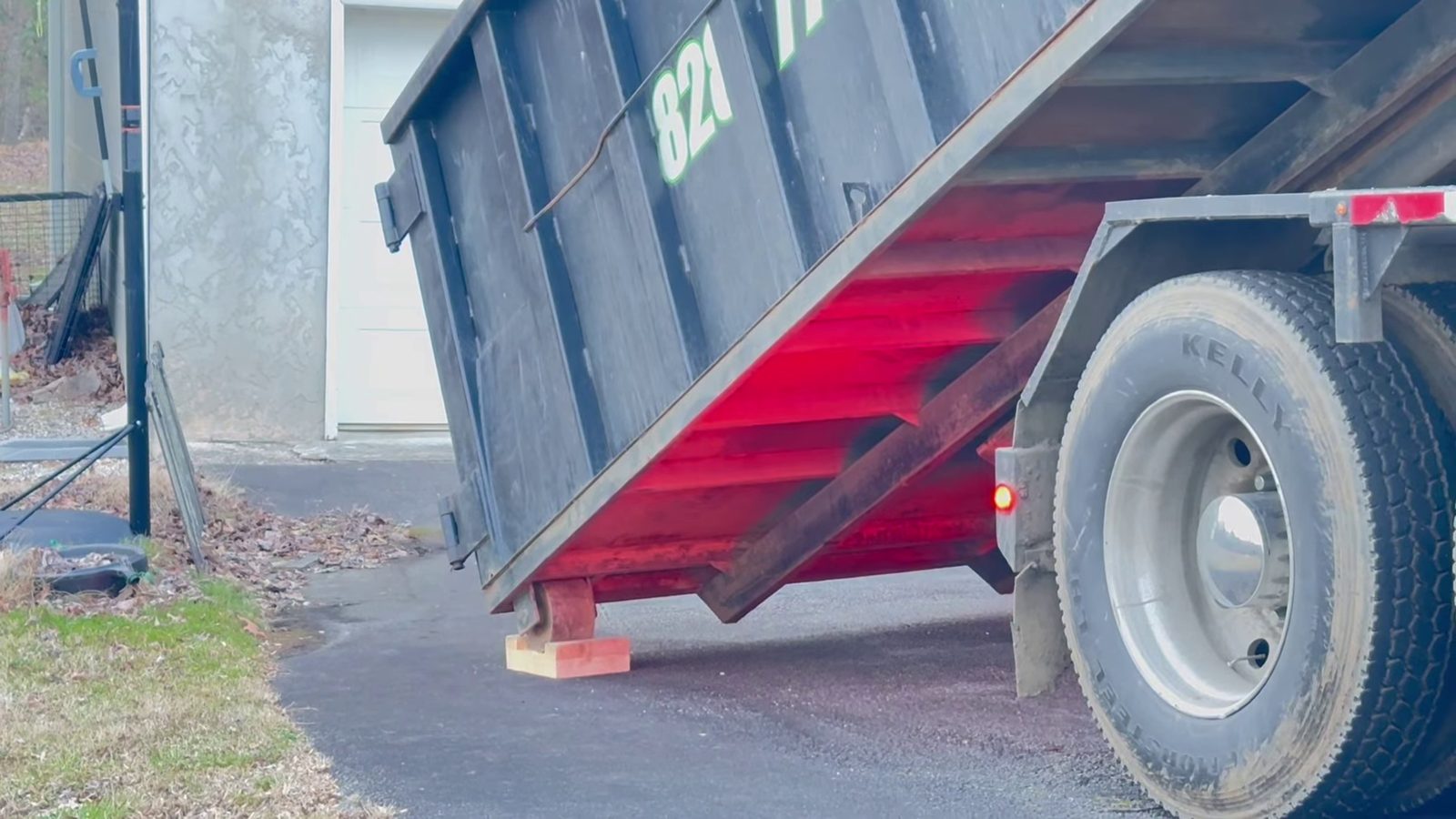
- Full-length plywood runners (3/4-inch or thicker): Cover the entire contact footprint of the container. This converts four small point loads into a distributed surface load. Required for warm-weather asphalt placements and any sloped placement where the downhill contact points carry extra pressure.
- Outrigger or spread pads under each leg: Engineered pads spread the point load better than nothing, but do not cover the full undercarriage. Better than no protection; not as effective as full runners on a soft or sloped surface.
- Steel plate for pavers or historic surfaces: Rigid and distributes load evenly; won't flex mid-load the way plywood can on an uneven surface.
- Downhill blocking on grades: On any sloped placement, cribbing or chocks at the low end of the container stabilizes the contact geometry and prevents the load from concentrating at the downhill edge during filling.
What you load matters for driveway stress too. The EPA's Construction and Demolition Materials guidance outlines how separating dense materials (concrete, brick, roofing shingles) from lighter mixed demo waste reduces total container weight significantly. Keeping a heavy-material category like concrete in a smaller container is both a cost decision and a driveway-protection decision. Certain materials are prohibited from dumpsters entirely: paints, solvents, batteries, and other items covered under the EPA's household hazardous waste framework cannot legally go in a roll-off. Knowing this before you sort avoids a rejected load and an unnecessary extra trip.
If the Driveway Cracks Anyway
Most dumpster-related driveway damage is cosmetic: a stress crack that was already starting, an edge that chipped under the leg, a surface impression where protection was inadequate. Structural failure — a panel dropping, a slab breaking through — is rarer and usually involves a driveway that was already compromised underneath, often by the kind of subsurface drainage erosion that Buncombe County's water events accelerate over time.
Document the driveway before delivery. Walk it, photograph every existing crack, edge chip, and patch. Five minutes of phone photos with a time stamp is your only evidence if a dispute arises. Reputable companies will do their own pre-placement walk; ask if yours does, and ask them to note any pre-existing condition in writing or by photo.
Responsibility terms vary by rental agreement. Most contracts place the burden on the customer to certify the placement surface as suitable, and limit the company's liability for damage to surfaces not flagged before delivery. Read the clause before signing. If you end up needing repair, driveway crack patching in Buncombe County typically runs $300–$900 for limited surface damage; full resurfacing costs considerably more depending on material type, slope, and total area — and that figure is independent of anything the rental agreement may or may not cover.