Henderson County's growth corridor sets the tempo
Fletcher occupies the most actively developing stretch of Henderson County. The I-26 corridor between downtown Hendersonville and Asheville Regional Airport has been absorbing new residential subdivisions, commercial pads, and retail development at a pace that few unincorporated communities in western North Carolina match. Older farm parcels are splitting into subdivisions; ranches along the county road grid are getting full gut renovations; infill lots along secondary roads are finally penciling out for builders who could not touch them five years ago. All of that activity produces construction and demolition debris that has to leave the site on a schedule that fits the job, not the hauler's calendar.
The practical consequence for a Fletcher contractor or homeowner is sequencing. Active build sites in this part of Henderson County often run multiple trades at once: framing, roofing, and rough mechanical work overlap more than they do in slower markets. Debris cannot pile up in the staging area while one trade waits for another. A construction dumpster that arrives on time, gets swapped when it fills, and gets pulled cleanly at job close is a production input, not an afterthought. That is the standard Ewing's holds itself to on these jobs.
Matching container size to scope
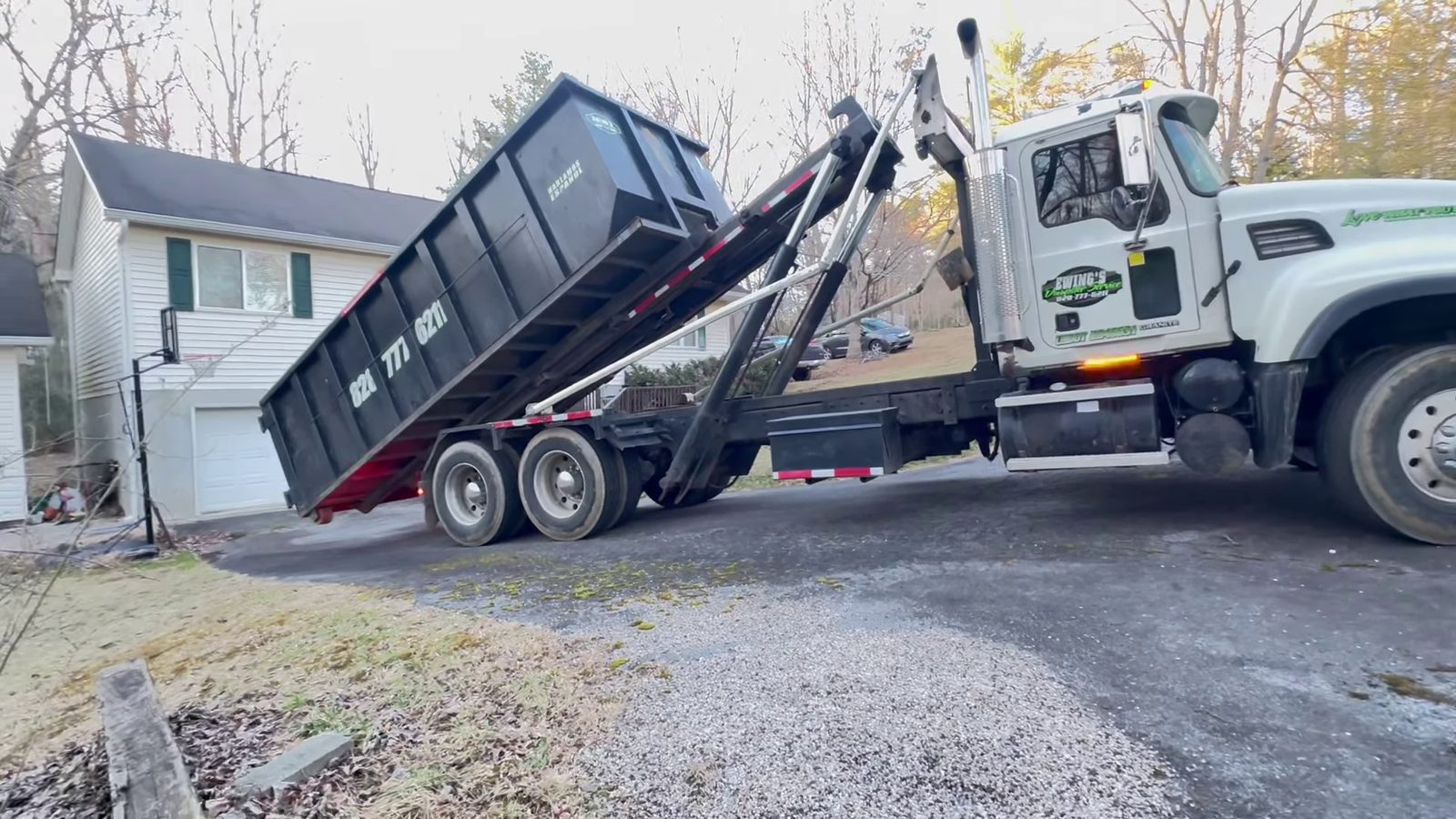
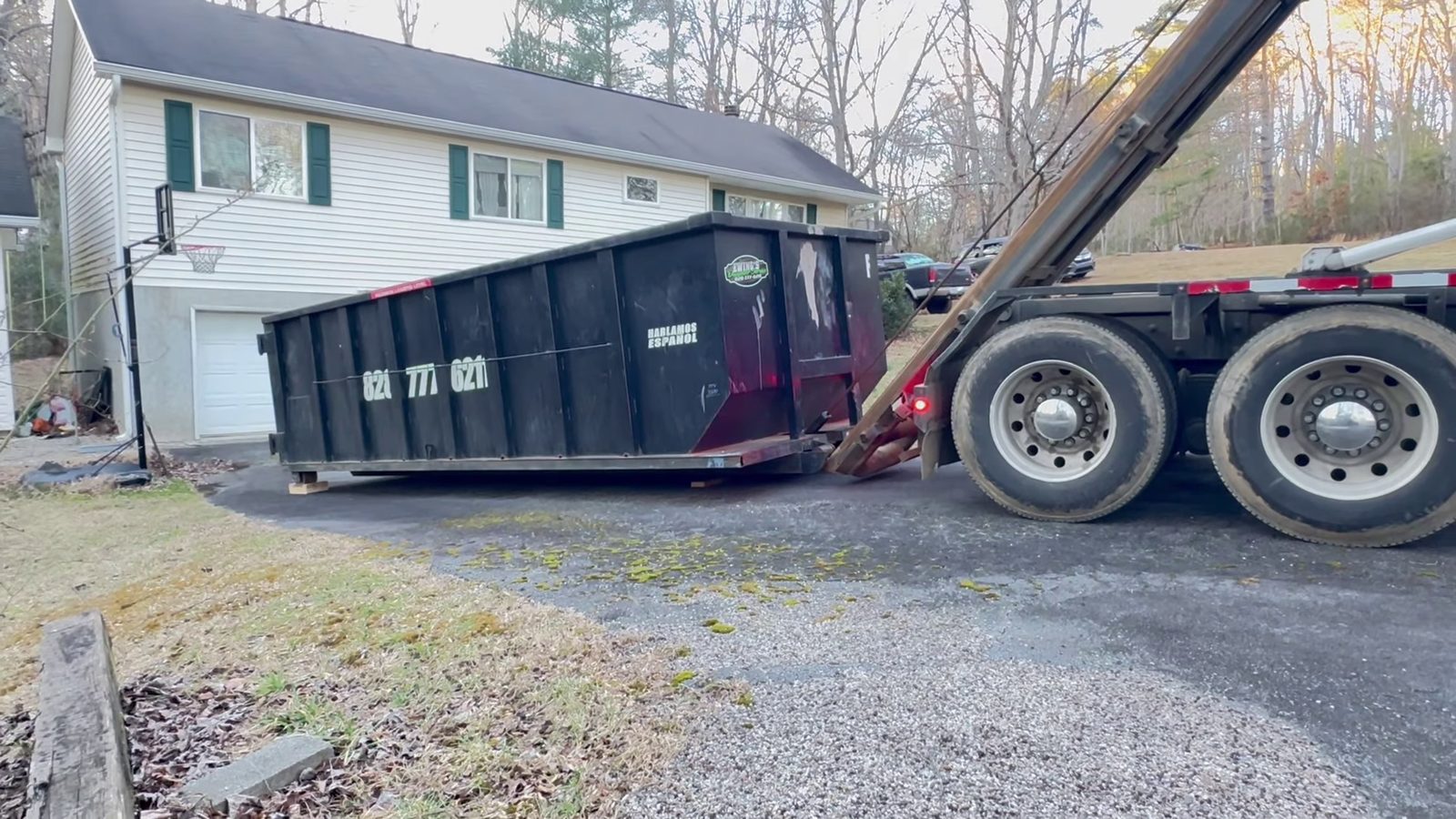
The two container sizes Ewing's runs in Fletcher cover the full range of residential and light commercial construction work. A 17-yard bin at $325 handles single-trade jobs: a full roofing tear-off on a standard ranch, a bathroom or kitchen gut, a deck removal, or window and door replacement with associated framing debris. A 30-yard container at $480 steps up for multi-trade renovations, combined roofing and siding jobs, new construction framing cleanup, and anything that involves stripping a structure down to the studs. Both prices include delivery and pickup to the Fletcher area and are posted as of January 2026, with no separate fuel surcharges.
| Job type | Container | Price |
|---|---|---|
| Roofing tear-off (single layer, standard residential) | 17-yard | $325 |
| Single bathroom or kitchen gut | 17-yard | $325 |
| Deck or porch demolition | 17-yard | $325 |
| Multi-room renovation or combined trades | 30-yard | $480 |
| New construction framing debris | 30-yard | $480 |
| Full gut renovation (studs-out) | 30-yard | $480 |
Dense demolition materials change the weight picture before they change the volume picture. Concrete block, brick, ceramic tile, and multilayer roofing tear-off are heavy loads relative to their cubic feet. The weight limit guide explains the per-ton thresholds and what an overweight load means for delivery logistics on a tight job-site access road in Henderson County's hilly terrain.
Placement and permits in unincorporated Fletcher
Fletcher is an unincorporated community, which means there is no city building department or municipal permit desk. If a container needs to occupy any part of a state-maintained road, shoulder, or right of way, the responsible agency is the NC Department of Transportation, which issues encroachment agreements for temporary obstructions on state roads. NCDOT's process applies to the state-numbered roads that make up most of Fletcher's main corridors, and the contractor or property owner, not the hauler, typically pulls that agreement before the bin arrives.
Placement on private property such as a driveway, gravel staging area, or a new construction lot apron does not require a street permit. It does have to follow safe-access rules: clear of egress doors and windows, clear of overhead electrical service, and not over a septic tank or drain field. The International Code Council codes that Henderson County enforces include provisions for on-site waste container placement on active construction sites. When access is tight, flag the driveway grade or access width at booking so Ewing's can confirm truck clearance before delivery day.
What goes in and what stays out
Standard construction and demolition materials go in without restriction: dimensional lumber, drywall, roofing shingles and underlayment, flooring, windows, doors, insulation, and non-hazardous demo debris in any combination. The EPA's C&D materials guidance defines this waste stream, and it covers the overwhelming majority of residential construction output in Henderson County. If it was part of the building and it is not chemically hazardous, it goes in the bin.
What does not go in: liquid paint, solvents, adhesives, pesticides, motor oil, fluorescent tubes, and anything classified as hazardous waste under federal or state rules. For older structures in Henderson County, pre-1980 materials require additional scrutiny before demo debris goes in the bin — asbestos-containing board, floor tile from that era, and lead-painted components need separate handling. The NC DEQ Solid Waste Section governs what North Carolina landfills can accept, and those rules apply to what leaves the bin at disposal. Flag the age and condition of the structure at booking if any prohibited materials may be present — it avoids a resorting fee and a delayed pickup.
Storm debris and Henderson County's weather record
Henderson County sits in the southern Blue Ridge, and its storm history is part of the planning picture for anyone running a construction project here. The county has seen 16 federal disaster declarations across 1978-2026, most of them in the storm and flood category — events that strip siding, blow roofs, down trees onto structures, and saturate wall assemblies with water. Storm cleanup debris can share a bin with standard C&D waste provided no hazardous materials are present. The weight caution applies more sharply on storm jobs than on dry demolition: saturated insulation, wet OSB, and water-logged dimensional lumber are substantially heavier per cubic yard than dry equivalents. When a storm event overlaps with an active renovation on the same property, Ewing's can stage and swap multiple bins to keep both work streams moving without delaying the contractor schedule. Book with a note on the event timeline so scheduling can account for the load type.