What Asheville's terrain settles before price does
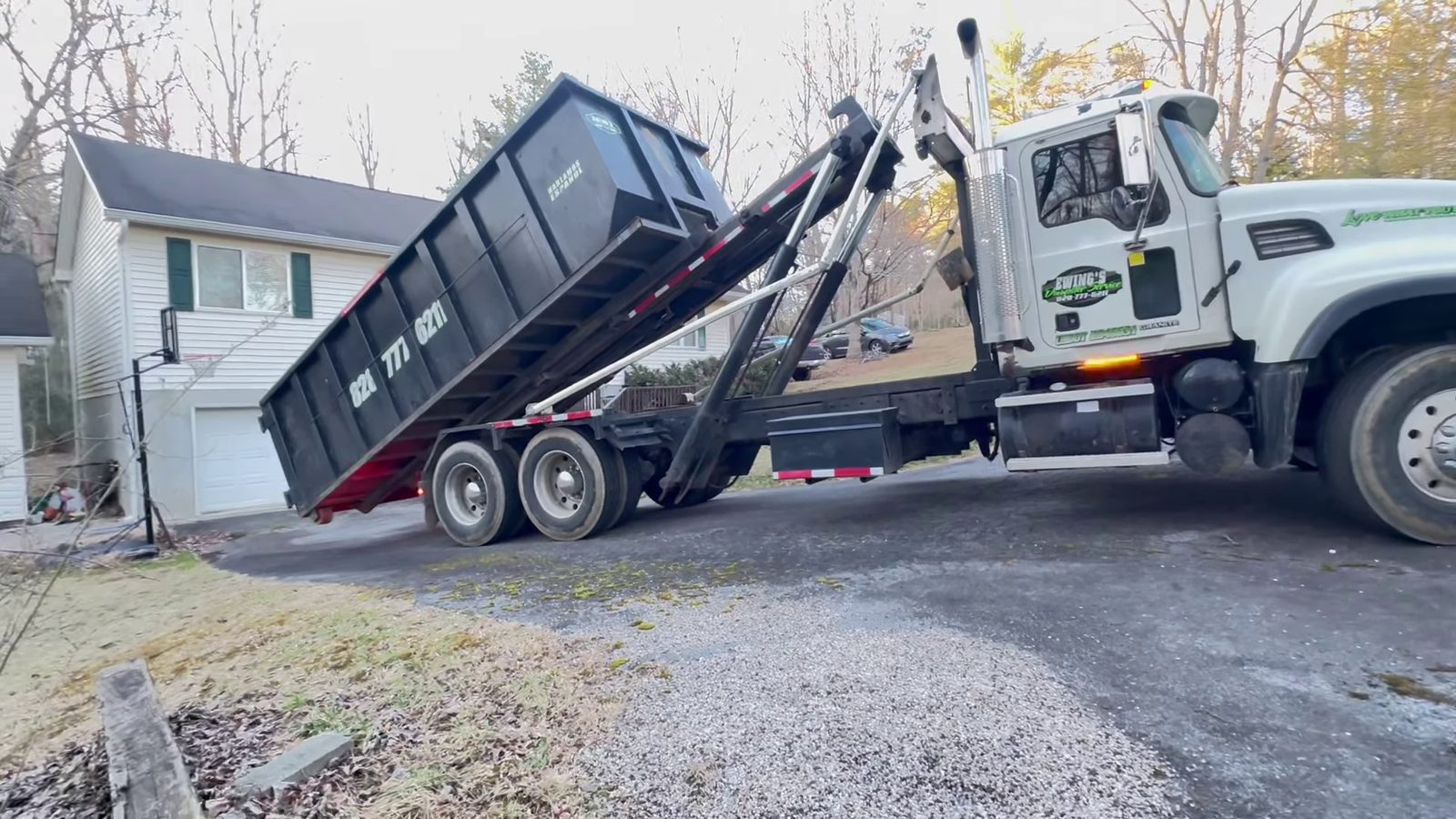
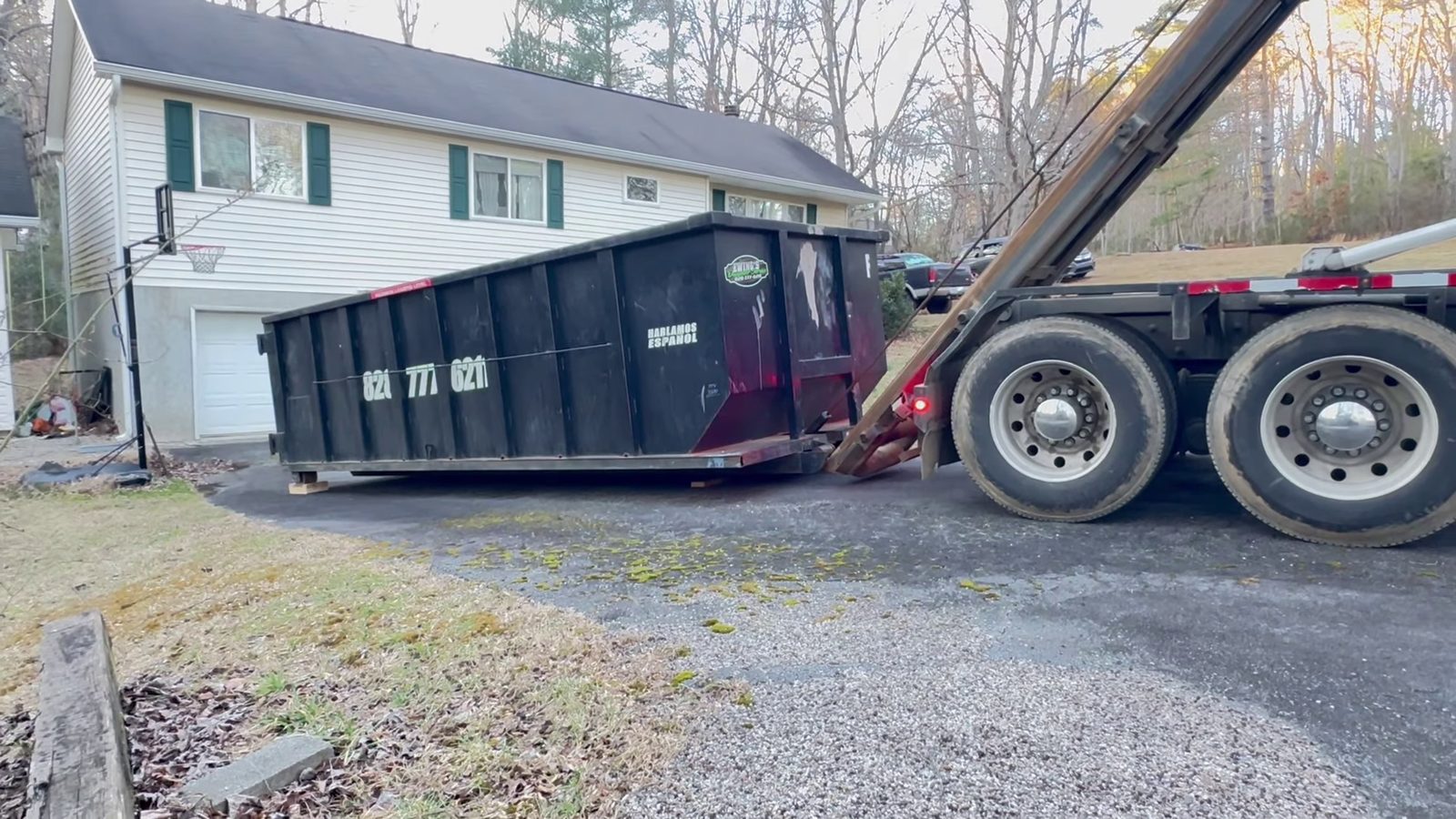
Asheville sits in a bowl in the Blue Ridge, and a lot of the neighborhoods people most want to clean out were built before anyone planned for a 22-foot roll-off container to park out front. Montford, Kenilworth, West Asheville's older grid, the North Asheville streetcar neighborhoods — these are properties with steep driveways, narrow streets that bend uphill between mature trees, and lots platted long before modern delivery trucks existed. That access question is the first cut in a dumpster rental vs junk removal decision in Buncombe County, and it matters more than price when it genuinely rules one option out.
If a container can land within reach of the debris — a driveway with a workable grade, a flat side yard, street placement where a permit is feasible — a dumpster almost always wins on cost. At $199 for a 10-yard unit and $280 for a 15-yard unit (posted January 2026, delivery and pickup included), Ewing's pricing undercuts what two crew members charge per hour once you factor total labor time on a medium-sized cleanout. For anything approaching a full room or more of debris, volume math favors the container.
If access is blocked — steep grade, tight turn off a narrow residential street, overhanging canopy, shared alley barely wide enough for a passenger car — junk removal crews work in spaces a container never could. For whole-house or multi-room estate cleanouts where debris staging is impractical, the full cleanout rental guide covers how that decision plays out at scale. The practical field test: stand at the edge of the debris and ask whether a large pickup truck could park within 20 feet. If yes, a dumpster likely fits. If no, junk removal is the realistic option regardless of price.
What you're actually paying for with each service
A dumpster rental puts a container on your property; you fill it on your schedule during the rental window, and the hauler picks it up and handles disposal. You pay for the container, transportation, and tipping fees — not for anyone else's labor. A junk removal service sends a crew who loads, hauls, and handles disposal; you pay for all of that labor, which makes the per-cubic-yard cost higher, sometimes substantially so. Neither model is wrong — they fit different job profiles, and Buncombe County jobs tend to split predictably by volume and access.
The table below covers common job types and which service typically costs less, using Ewing's January 2026 posted pricing as the dumpster column baseline:
| Job scope | Lower-cost option | Dumpster range |
|---|---|---|
| One-room cleanout, driveway access available | Dumpster | $199–$280 |
| Garage cleanout, 10–15 cubic yards of mixed debris | Dumpster | $199–$280 |
| Kitchen or bathroom renovation demo | Dumpster | $199–$280 |
| Single large item — sofa, appliance, mattress | Junk removal | Container oversized for one item |
| No driveway access or lot too steep for delivery | Junk removal | Container may not be placeable |
| Same-day load and haul with no staging time available | Junk removal | Dumpster requires a rental window |
For a detailed breakdown of what moves the per-job price on the 10-yard unit specifically, the 10-yard dumpster cost guide covers location, overage charges, and rental period differences in this area.
Three situations where junk removal is the honest answer
Access rules out the dumpster. A surprising share of Asheville properties built before 1960 sit on lots that cannot accommodate a container delivery anywhere near the debris. Steep driveways, tight turns off narrow streets, mature trees with low canopy, shared alleyways — any of these can make a useful placement physically impossible. Junk removal crews work from the front door to the curb with hand trucks and dollies; that path exists even when container placement doesn't. If you've looked at your driveway and had any doubt about the approach, describe the property before booking either service.
You have one or two items. Renting a 10-yard container for a single couch and a broken treadmill is expensive on a per-pound basis. Junk removal services price by the item or by the fraction of a truck load and handle small jobs efficiently. The dumpster earns its posted price when volume justifies the fixed cost — a full room, a full garage, a renovation demo — not for a one-item haul where the container sits mostly empty for days.
You can't sort and stage. Some cleanouts — a family estate after a loss, a water-damaged storage room, a situation that got out of hand over years — involve mixed loads of furniture, boxes, and debris that can't realistically be separated before removal. Junk removal crews deal with the mix on the spot and make removal decisions in real time. With a dumpster, you're the person at the container making those calls under time pressure. For a large staged cleanout where you have time and reasonable access, a full garage cleanout is almost always a dumpster job on cost alone — but that assumes you can get the container there.
What goes in neither service — the NC disposal rules that apply to both
Regardless of which service you book, North Carolina has clear rules on what can enter the standard solid-waste stream. The NC DEQ Solid Waste Section governs what county landfills and transfer stations accept; a hauler who takes prohibited material faces disposal rejections that add cost, delay, or in some cases legal liability. These restrictions apply equally to roll-off dumpster loads and junk removal truck loads — the hauler's exposure is the same either way, and they will charge accordingly or refuse the load outright.
Items that cannot go in a standard dumpster or junk removal load in Buncombe County include:
- Tires — not accepted at most municipal facilities
- Appliances containing refrigerant (refrigerators, window AC units, dehumidifiers) — require certified refrigerant recovery before disposal
- Electronics (TVs, monitors, computers) — North Carolina has specific e-waste disposal requirements
- Paints, stains, and solvents — classified as household hazardous waste under US EPA guidance
- Propane tanks and fuel canisters
- Automotive and lithium batteries
Under the federal Resource Conservation and Recovery Act (RCRA), certain waste streams require specific disposal pathways regardless of volume, and those rules reach into residential cleanouts when the material meets the definition. Buncombe County has experienced significant flood and weather events — 19 federal disaster declarations over 1973-2026 — and after major water damage, appliances are a common sorting problem that surprises homeowners. A dehumidifier that ran through a flood still contains refrigerant; it doesn't become ordinary debris because water damaged it.
Dumpster placement and right-of-way permits in Asheville
Where the container sits matters legally, not just logistically. A dumpster placed on your own private driveway or property in Buncombe County generally requires no special permit for the placement itself. The situation changes when street placement is the only viable option — a common reality in Asheville's older neighborhoods where off-street staging simply isn't available on compact urban lots.
For containers in a state road right-of-way, an encroachment permit from the NC Department of Transportation is typically required. For streets within Asheville city limits, the City of Asheville handles right-of-way permits for temporary equipment placements and may require flagging, cones, or lighting depending on the location, traffic volume, and sight lines at the placement spot. Downtown Asheville and streets near the urban core have tighter requirements and generally need more lead time to process.
The practical rule: if any part of the container will overhang the street edge or occupy a public sidewalk, ask before you book — not after the container lands. Permit fees for temporary street placement are typically modest and far less costly than a ticket, a tow, or a mid-job forced move. Reputable haulers coordinate permits routinely, but confirming it was done is the homeowner's interest, not just the contractor's. For jobs where placement constraints are the deciding factor between a container and a crew, the 10-yard dumpster cost guide covers how delivery location affects final pricing, and the cleanout rental page walks through access planning for large jobs on difficult properties.